
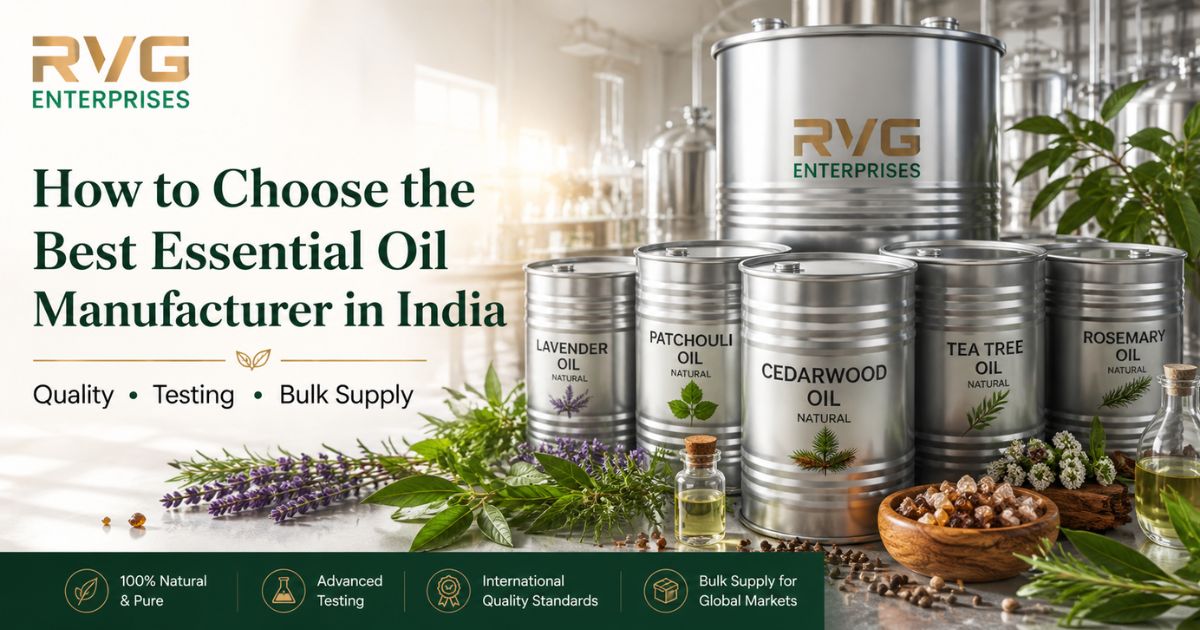
India has a strong and growing presence in the global natural ingredients industry. From essential oils and carrier oils to botanical extracts, resinoids, and other aromatic ingredients, Indian manufacturers serve businesses across cosmetics, personal care, fragrance, aromatherapy, soap, wellness, and related industries.
However, choosing the right essential oil manufacturer in India is not simply about finding the lowest price. For B2B buyers, product quality, consistency, testing, documentation, manufacturing capabilities, sourcing, packaging, and supply reliability can have a direct impact on the quality and profitability of finished products.
Whether you are a cosmetics manufacturer, fragrance company, aromatherapy brand, soap manufacturer, pharmaceutical business, distributor, importer, or personal-care company, selecting the right supplier is an important purchasing decision.
This guide explains what you should evaluate before choosing an essential oil supplier in India and how to identify a manufacturer that can support your business requirements over the long term.
Why Choosing the Right Essential Oil Manufacturer Matters
Essential oils are concentrated natural ingredients, and their characteristics can vary depending on botanical species, geographical origin, harvesting conditions, processing methods, storage, and other factors.
For businesses using essential oils in commercial formulations, inconsistency between batches can create challenges in production and finished-product performance.
A reliable supplier should therefore offer more than a product catalogue. You should look for a company that can demonstrate appropriate quality practices, provide relevant technical documentation, maintain consistent supply, and understand your application.
Choosing the right supplier can help you:
- Maintain consistent product quality
- Reduce the risk of batch-to-batch variation
- Improve production planning
- Simplify supplier management
- Obtain appropriate technical documentation
- Support your regulatory and quality requirements
- Build a dependable long-term supply relationship
1. Understand Your Essential Oil Requirements First
Before comparing essential oil manufacturers in India, define exactly what your business requires.
Essential oils are used across many industries, and the appropriate product specifications can differ depending on the application.
For example, you may be sourcing essential oils for:
- Cosmetics and skincare
- Hair-care products
- Personal-care formulations
- Fragrance and perfumery
- Soap and bath products
- Aromatherapy
- Wellness products
- Pharmaceutical applications
- Candles and home fragrance
- Natural cleaning products
- Distribution and resale
Start by identifying the essential oil you need, its botanical name, plant part, preferred origin, required quantity, packaging format, and intended application.
You should also determine whether you require specific analytical reports, certificates, specifications, or other technical documentation.
A professional natural essential oil manufacturer should be able to discuss these requirements with you and provide appropriate product information.
2. Check Whether You Are Buying Directly From a Manufacturer
One of the most important questions for B2B buyers is whether a company actually manufactures the products it supplies.
Some businesses operate primarily as traders or distributors, while others have their own manufacturing and processing capabilities. Both models can have their place, but buyers should understand the supply chain before entering a long-term relationship.
Ask potential suppliers:
- Are the products manufactured in-house?
- Which essential oils are produced directly?
- Where are raw materials sourced?
- What distillation or processing capabilities are available?
- What is the manufacturing capacity?
- How are batches controlled?
- Can the company support recurring bulk orders?
If you are specifically looking for an essential oil manufacturer in India, transparency about manufacturing capabilities is an important part of supplier evaluation.
3. Evaluate Raw Material Sourcing
The quality of an essential oil begins with the quality of its raw materials.
The botanical species, plant part, growing conditions, geographical origin, harvesting period, handling, and storage can all influence the final product.
A reliable manufacturer should have a systematic approach to sourcing and evaluating botanical raw materials.
When assessing a supplier, ask about:
- Botanical identification
- Plant part used
- Raw-material origin
- Raw-material inspection
- Storage conditions
- Supplier or farmer relationships
- Traceability
- Seasonal variations
Good traceability can help manufacturers maintain better consistency and investigate quality issues when necessary.
For businesses purchasing bulk essential oils, understanding the raw-material supply chain is particularly important because natural materials can vary from season to season.
4. Assess Essential Oil Quality
Essential oil quality should be evaluated using more than appearance or aroma alone.
Depending on the specific oil, quality assessment may involve:
- Appearance
- Colour
- Odour
- Relative density
- Refractive index
- Optical rotation
- Chemical composition
- Microbiological parameters, where applicable
- Authenticity and adulteration checks
The exact parameters will depend on the essential oil and its intended application.
When comparing suppliers, ask how they control batch-to-batch variation.
Natural ingredients may show some degree of variation, so the manufacturer’s ability to monitor, document, and manage this variation is an important consideration.
A dependable essential oil supplier should be able to explain its quality-control procedures clearly.
5. Ask for a GC-MS Report for Natural Essential Oils
A GC-MS report for Natural essential oils is an important analytical document for many B2B buyers.
Gas chromatography–mass spectrometry can help identify the chemical constituents present in an essential oil and provide a chemical profile that can be compared with expected characteristics for the product.
When reviewing a GC-MS report, check whether:
- The product name is clearly identified
- The botanical name is mentioned
- The batch or sample is identifiable
- Major constituents are listed
- The chemical profile is appropriate for the essential oil
- Testing or laboratory information is available
- The supplier can explain the results when required
GC-MS should not be treated as the only measure of essential oil quality. However, it can be an important part of a broader quality and authenticity evaluation.
If you are purchasing essential oils in commercial quantities, ask whether relevant analytical documentation is available for the supplied batch.
6. Review the COA Before Commercial Purchasing
A COA for essential oils, or Certificate of Analysis, provides information about the quality parameters tested for a particular batch.
For B2B buyers, batch-specific documentation can support:
- Incoming quality inspection
- Supplier approval
- Batch traceability
- Internal quality records
- Production documentation
- Customer or regulatory requirements
A COA may include product identification, batch number, specifications, test parameters, results, and other relevant information.
Before approving a supplier, ask whether the COA is specific to the batch being supplied and whether its parameters match your company’s purchasing requirements.
Don’t hesitate to discuss any unfamiliar specification or test result with the supplier’s technical team.
7. Compare Samples Before Comparing Prices
Price is an important consideration, but it should not be the only factor used to select an essential oil supplier.
Before placing a bulk order, request samples from shortlisted suppliers and compare them using consistent criteria.
Depending on your application, you can evaluate:
- Aroma profile
- Colour and appearance
- Technical specifications
- GC-MS profile
- Documentation
- Formulation performance
- Packaging
- Supplier responsiveness
For cosmetics, fragrance, personal-care, and soap manufacturers, testing the essential oil in the actual formulation can provide useful information about its performance.
A cheaper essential oil is not necessarily the most economical option if it causes formulation problems, inconsistent batches, or higher rejection rates.
For wholesale essential oils in India, evaluate the overall value rather than comparing only the price per kilogram.
8. Check Manufacturing Capacity and Scalability
A supplier may provide excellent samples but still be unable to meet your commercial requirements.
Before committing to a supplier, understand its manufacturing capacity and ability to scale.
Important questions include:
- What batch sizes can be produced?
- What are the normal lead times?
- What quantities can be supplied regularly?
- Can production increase as your business grows?
- How are seasonal supply challenges managed?
- What packaging formats are available?
- Can recurring orders be scheduled?
For a small brand, flexibility may be more important than maximum production capacity. For a large cosmetics or fragrance manufacturer, consistent high-volume supply may be a priority.
The best bulk essential oil supplier is therefore the one whose production capabilities match your actual purchasing requirements.
9. Evaluate MOQ, Lead Times, and Supply Continuity
Minimum order quantities and lead times should be discussed before placing an order.
Different B2B customers have different purchasing patterns. A startup may need a few kilograms, while an established manufacturer may purchase hundreds of kilograms or several tonnes.
Clarify:
- Minimum order quantity
- Sample quantity
- Standard lead time
- Bulk packaging
- Repeat-order lead time
- Seasonal availability
- Production scheduling
- Forecasting requirements
Clear communication about these points can help prevent production delays.
A reliable essential oil supplier in India should provide realistic information about availability and delivery schedules.
10. Check Packaging and Storage Practices
Proper packaging and storage are important for maintaining the condition of essential oils throughout transportation and inventory storage.
Packaging requirements can vary according to the specific oil, quantity, transportation method, and destination.
Ask your supplier about packaging options for:
- Samples
- Small commercial quantities
- Bulk orders
- Drums
- Export shipments
Also check whether product labels provide important information such as product identification and batch details.
For importers and distributors, packaging should also be suitable for long-distance transportation and the expected storage conditions.
11. Choose a Manufacturer That Understands Your Industry
The best supplier for a fragrance company may not necessarily be the best supplier for a cosmetic or aromatherapy business.
Essential Oil Manufacturer for Cosmetics
An essential oil manufacturer for cosmetics should understand the needs of cosmetic formulators and provide relevant product specifications and documentation.
Cosmetic manufacturers may also need information that supports formulation development, quality control, and market requirements.
Essential Oil Manufacturer for Fragrance Industry
Fragrance manufacturers often focus heavily on aroma profile, sensory characteristics, chemical composition, and batch consistency.
An essential oil manufacturer for the fragrance industry should be able to discuss these aspects and support repeat requirements.
Essential Oil Manufacturer for Aromatherapy
Aromatherapy brands may require clear botanical identification, product information, consistency, and appropriate quality documentation.
An essential oil manufacturer for aromatherapy should be able to provide the technical information needed for responsible product evaluation.
Pharmaceutical and Wellness Applications
Businesses operating in pharmaceutical or highly regulated applications may have additional quality, testing, documentation, and regulatory requirements.
These requirements should be communicated to the supplier before commercial purchasing.
12. Review Technical and Regulatory Documentation
A product sample alone is not enough for many B2B procurement processes.
Depending on the application and destination market, you may require:
- Certificate of Analysis
- GC-MS report
- Product specification sheet
- Safety documentation
- Allergen information
- Origin information
- Technical data
- Other product-specific declarations
If you are sourcing from an essential oil exporter in India, communicate your destination-market requirements before finalizing the order.
This is particularly important for importers because documentation requirements can vary between countries and applications.
13. Consider the Supplier’s Product Portfolio
Businesses that use multiple natural ingredients may benefit from working with a supplier offering a broader portfolio.
In addition to essential oils, you may require:
- Carrier oils
- Natural extracts
- Resinoids
- Reconstitutes
- Other natural aromatic ingredients
A supplier with multiple relevant product categories can simplify procurement and reduce the need to coordinate with numerous vendors.
However, a large catalogue should not automatically be considered a sign of better quality.
Each product should still be evaluated according to its own specifications, testing, application, and supply requirements.
14. Evaluate Communication and Technical Support
A supplier’s communication can be a strong indicator of how easy the long-term business relationship will be.
During the supplier evaluation process, consider whether the company:
- Responds promptly to enquiries
- Understands technical questions
- Provides relevant documentation
- Supplies samples efficiently
- Explains specifications clearly
- Communicates lead times honestly
- Understands your application
- Provides support after the sale
A responsive supplier can make procurement, product development, quality checks, and repeat purchasing much easier.
15. Look for Long-Term Supply Reliability
Choosing an essential oil supplier should not be based only on your first purchase.
If the product becomes an important component of your formulation, you need confidence that the supplier can maintain supply over time.
Discuss:
- Expected annual volumes
- Forecasting
- Repeat-order requirements
- Production planning
- Seasonal availability
- Future volume increases
- Packaging requirements
- Supply continuity
This is especially important for manufacturers whose finished products are sold continuously.
The right supplier should be able to grow with your business and support increasing requirements where possible.
16. Watch for Common Red Flags
Before selecting an essential oil manufacturer in India, look carefully for potential warning signs.
Be cautious if a supplier:
- Offers an unusually low price without explaining the difference
- Cannot provide a clear botanical identity
- Provides generic or unclear documentation
- Cannot connect analytical reports with the relevant batch
- Avoids questions about sourcing
- Cannot explain quality-control procedures
- Makes unsupported claims about purity or quality
- Refuses to provide samples
- Gives unclear information about lead times
- Changes specifications without proper communication
A single issue may not necessarily mean the supplier is unsuitable, but several warning signs together should encourage a more detailed evaluation.
17. Use a Supplier Evaluation Scorecard
Instead of choosing a supplier based on one quotation, create a simple evaluation system.
| Evaluation Factor | What to Check |
|---|---|
| Product quality | Aroma, appearance, specifications, consistency |
| Testing | GC-MS and other relevant testing |
| Documentation | COA, specifications, technical documents |
| Manufacturing | Capacity, facilities, process controls |
| Raw materials | Sourcing and traceability |
| Samples | Quality and formulation performance |
| Supply | MOQ, lead time, scalability |
| Packaging | Product protection and suitability |
| Support | Communication and technical knowledge |
| Commercial value | Price and overall supply value |
You can assign different weights depending on your business.
For example, a fragrance company may prioritize aroma profile and batch consistency, while a distributor may place more emphasis on pricing, packaging, availability, and product range.
Why Consider RVG Enterprises?
For B2B businesses looking for natural aromatic ingredients from India, RVG Enterprises offers a range of products designed to support different commercial requirements.
The company’s product portfolio includes essential oils, carrier oils, natural extracts, resinoids, reconstitutes, and related natural ingredients.
For businesses evaluating RVG Enterprises as a potential supplier, the same professional procurement process should be followed: review product samples, specifications, relevant analytical documentation, packaging, minimum order quantities, lead times, and application suitability.
This approach allows buyers to make an informed decision based on their specific requirements rather than choosing a supplier based solely on price.
Final Checklist Before Choosing an Essential Oil Manufacturer in India
Before approving an essential oil supplier, ask the following questions:
- Is the botanical identity clearly specified?
- Have you received and evaluated a sample?
- Are the product specifications available?
- Can the supplier provide a relevant GC-MS report?
- Is a batch-specific COA available?
- Can the supplier explain its raw-material sourcing?
- Is there adequate manufacturing capacity?
- Can the supplier maintain consistent quality?
- Are MOQ and lead times clearly defined?
- Is the packaging appropriate for your requirements?
- Can the supplier support your specific industry?
- Can it handle increasing volumes in the future?
- Is communication clear and professional?
If the answer is yes to most of these questions, you have a stronger foundation for establishing a long-term B2B supply relationship.
Conclusion
Choosing the right essential oil manufacturer in India requires a complete evaluation of quality, sourcing, manufacturing, testing, documentation, pricing, packaging, supply capacity, and technical support.
For B2B buyers, the lowest price should not be the only deciding factor. Consistent quality, reliable documentation, dependable supply, and clear communication can have a much greater impact on long-term business performance.
Whether you are a cosmetics manufacturer, fragrance company, soap manufacturer, aromatherapy brand, pharmaceutical business, personal-care company, distributor, or importer, selecting the right essential oil supplier in India can help you maintain product consistency and reduce supply-chain risks.
India offers a strong sourcing ecosystem for natural aromatic ingredients. By evaluating manufacturers systematically, comparing samples and documentation, and considering long-term supply capabilities, businesses can make more confident procurement decisions.
RVG Enterprises provides essential oils and related natural ingredients for B2B requirements. Businesses can evaluate its products and capabilities based on their specific quality, application, quantity, documentation, and supply requirements.
A reliable supplier is not simply the company that offers the lowest quotation. It is the partner that can consistently deliver the right product, quality, documentation, and service as your business grows.
FAQs
RVG Enterprises offers a range of natural ingredients for B2B requirements, including essential oils, carrier oils, natural extracts, resinoids, and reconstitutes. The product range can support businesses in cosmetics, personal care, fragrance, aromatherapy, soap, and related industries.
Yes, RVG Enterprises supplies essential oils in India for commercial and B2B requirements. Buyers can discuss their required oil, quantity, application, packaging, and technical documentation with the company.
RVG Enterprises caters to bulk essential oil requirements for businesses such as cosmetic manufacturers, fragrance companies, personal-care brands, aromatherapy businesses, distributors, and other commercial buyers. Bulk requirements can be discussed based on product and quantity.
RVG Enterprises can serve B2B requirements across industries such as cosmetics, personal care, fragrance and perfumery, aromatherapy, soap and bath products, wellness, and natural product manufacturing.
Businesses can consider RVG Enterprises based on their specific requirements for product range, quality, documentation, bulk supply, packaging, and long-term sourcing. Buyers can evaluate samples and relevant product information before selecting the ingredients suitable for their applications.
For More INFO, Visit:- RVG Enterprises