
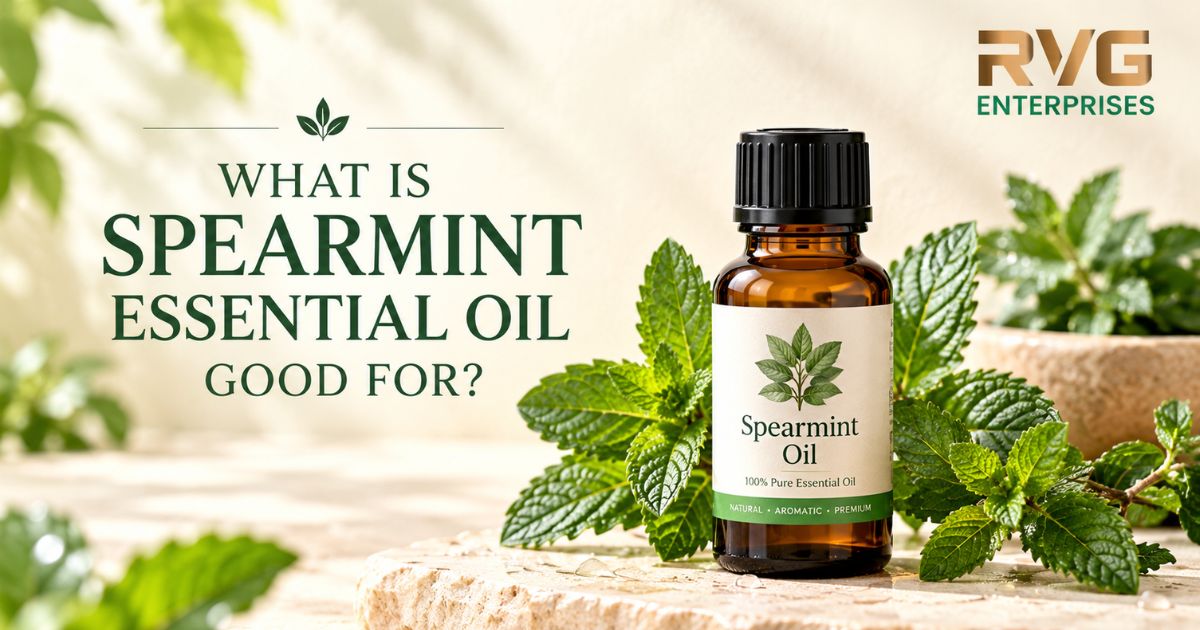
Spearmint essential oil is known for its fresh, sweet, and minty aroma. It is used in a variety of ways across aromatherapy, personal care, oral care, cosmetics, and scented products. Extracted from the plant Mentha spicata, this oil is milder than peppermint oil, which is why it is frequently used in products designed to provide a clean and refreshing experience.
But what is spearmint essential oil used for, and how can it be used safely?
Spearmint essential oil is often used to scent spaces like homes or offices, enhance the fragrance of personal care products, and create refreshing aromatic blends. Additionally, it is used in oral care, hair care, skincare, and the creation of perfumes. However, scientific evidence regarding its specific medicinal benefits is limited. Therefore, it is important to distinguish between its established, traditional uses and any unproven health claims.
In this guide, RVG Enterprises explores the primary uses of spearmint essential oil, its potential benefits, practical applications, safety precautions, and how to choose the right product for your specific needs.
What is Spearmint Essential Oil?
Spearmint essential oil is a concentrated, aromatic extract derived from the spearmint plant (scientific name: Mentha spicata). Steam distillation is a commonly used extraction method that isolates the plant’s volatile aromatic compounds.
One of its key components is carvone, which contributes to spearmint’s characteristic sweet, fresh, minty aroma. Its precise chemical composition can vary depending on the plant material, growing conditions, origin, and processing method.
Spearmint oil is used across various industries, including:
- Aromatherapy and home fragrance
- Toothpaste and mouthwash formulations
- Soaps, body washes, and personal care products
- Haircare and cosmetic formulations
- Perfumes and fragrance blends
- Flavored products where the use of the oil is specifically permitted and appropriate for that application
Its versatility makes it useful for both individual consumers exploring aromatic products and manufacturers developing mint-scented formulations.
What is spearmint essential oil used for? 7 uses and benefits
Creating a fresh and invigorating aromatherapy experience
The most popular use of spearmint essential oil is in aromatherapy. Its sweet, fresh scent can help create a pleasant and invigorating atmosphere in homes, workplaces, spas, or wellness centers.
Some people enjoy this minty aroma while working, studying, or performing daily tasks, as it provides a sense of freshness and vitality.
How to use it: Add spearmint essential oil to a diffuser, following the manufacturer’s instructions. Start with the minimum recommended amount and ensure the space is well-ventilated.
Although its scent can help create a pleasant environment, there is insufficient evidence to suggest that spearmint essential oil is reliably effective for enhancing concentration, treating anxiety, or improving cognitive performance.
Adding a fresh mint scent to oral care products
Spearmint is primarily associated with products designed for fresh breath and oral hygiene. Due to its pleasant minty aroma, it is used as a fragrant ingredient in toothpaste, mouthwash, breath fresheners, and various other oral care formulations.
For manufacturers, spearmint essential oil offers an alternative to the intense scent of peppermint, providing a milder, sweeter mint fragrance instead.
However, a pleasant scent or taste does not imply any proven benefit for oral health. Spearmint oil should not be considered a substitute for brushing with fluoride toothpaste, flossing, or receiving professional dental care.
A note on formulations: Essential oils intended for oral care must meet strict standards for safety, purity, quality, and regulatory compliance. It should not be assumed that an oil suitable for its fragrance is also safe for ingestion or direct application in the mouth.
Enhancing the sensory appeal of skincare products
Spearmint essential oil is used in certain cosmetic and personal care products due to its refreshing scent.
Depending on the type of product and its intended use, it may be included in:
- Cleansers and rinse-off products
- Body washes and soaps
- Lotions and creams
- Other scented cosmetic products
Its minty aroma can enhance the experience of a product, especially when a fresh, herbal scent is desired.
However, spearmint essential oil should not be presented as a proven treatment for acne, pigmentation, eczema, or other skin conditions. There is very limited research on its effectiveness for these issues in humans. Furthermore, concentrated essential oils can cause skin irritation or trigger allergic reactions.
Safety tip: Never apply undiluted spearmint essential oil directly to your skin. Always use a properly prepared, diluted product, and be sure to perform a ‘patch test’ before applying it to a larger area of your skin.
Enhancing Formulations for Haircare and Scalp Products
Spearmint essential oil is also used in haircare products. Its clean, minty aroma complements shampoos, conditioners, scalp-care products, and hair masks.
For cosmetic manufacturers, it serves as an excellent option for adding a fresh, herbal scent to everyday haircare products.
However, it is important to distinguish between a pleasant, fresh fragrance and scientifically proven benefits for hair. There is insufficient reliable evidence to claim that spearmint essential oil alone can prevent hair loss, promote hair growth, or treat scalp conditions.
How it can be used: Product formulators may consider incorporating spearmint oil as a fragrance component in haircare products. In doing so, they must carefully account for the concentration used, the specific type of product, the intended method of application, and relevant safety standards.
Consumers should avoid applying the concentrated oil directly to the scalp—especially if they have sensitive skin or existing scalp issues.
Developing Natural Fragrances and Perfume Blends
Spearmint essential oil can impart a fresh, verdant, and sweet, mint-like note to fragrances. Its distinctive aroma pairs uniquely well with floral, herbal, woody, and citrus scents.
It can be incorporated into the following types of formulations:
- Fine fragrances and perfume blends
- Room fragrances
- Scented soaps and body care products
- Selected home fragrance applications
- Aromatic blends for spas and wellness centers
A balanced fragrance profile can be developed by combining spearmint oil with compatible aromatic ingredients. The precise blend should be determined through formulation testing, stability testing, and appropriate safety assessments.
For fragrance manufacturers, the stability of the scent and the certified specifications of the oil are critical factors when selecting raw materials.
Creating Refreshing Massage and Body Care Products
Spearmint essential oil can be used as a fragrant ingredient in massage oils and body care products. Its minty aroma can add a refreshing quality to the massage experience.
However, the pleasant sensation provided by a scented massage product should not be taken as evidence that the oil can relieve muscle pain, inflammation, or other medical conditions.
How to use it safely: Choose a product formulated by a professional, or dilute the essential oil in a suitable carrier oil, following safety guidelines for essential oils. Before using it over a larger area, perform a patch test by applying the product to a small section of your skin.
Avoid applying it to broken, irritated, or sensitive skin, and keep it away from your eyes and other delicate areas of the body.
Incorporating Spearmint Flavor into Flavor Formulations
Spearmint is associated with mint-flavored confectionery, beverages, and various other flavored products. Flavor manufacturers may use spearmint essential oil, provided that its identity, purity, and regulatory suitability align with the intended application.
Great caution must be exercised in this regard, as not all essential oils are suitable for food use. Products intended for aromatherapy, perfumery, or cosmetics should never be used directly in food or beverages.
Before incorporating such a product into a flavor formulation, manufacturers must verify documentation regarding its intended use, its suitability for food-grade applications, compliance with applicable legal requirements, and recommended usage limits.
Consumers should not ingest spearmint essential oil, nor should they add it to beverages, dishes, or supplements, unless the specific product is explicitly intended for such use and the accompanying instructions confirm this. When in doubt, consult a qualified healthcare professional or an expert in food formulation.
What are the main benefits of spearmint essential oil?
The most practical benefits of spearmint essential oil are linked to its aroma and its versatility for use in various types of formulations.
Here is a brief overview:
| Application | Potential value | Important limitation |
| Aromatherapy | Creates a fresh, minty atmosphere | Specific medical or cognitive benefits are not established |
| Oral care | Adds a pleasant mint aroma and flavour profile | Does not replace dental hygiene |
| Skincare | Contributes fragrance to suitable formulations | Not a proven acne or skin-disease treatment |
| Haircare | Adds a refreshing herbal scent | Hair-growth benefits are unproven |
| Perfumery | Introduces sweet, fresh mint notes | Compatibility and stability require testing |
| Massage products | Enhances the aromatic experience | Does not establish pain-relief efficacy |
| Flavour development | Provides mint character in suitable products | Requires food-use approval and appropriate documentation |
This distinction matters: an ingredient used in creating a fragrance can hold real commercial value, even in the absence of any medically proven therapeutic benefit.
Spearmint oil vs. peppermint oil: What is the difference between them?
Spearmint and peppermint are distinct plants, and their essential oils differ in both scent and chemical composition.
| Feature | Spearmint essential oil | Peppermint essential oil |
| Botanical name | Mentha spicata | Mentha × piperita |
| Aroma | Sweet, fresh, herbal, minty | Sharper, more intense, minty |
| Characteristic constituent | Carvone is a major characteristic compound | Menthol is a major characteristic compound |
| Common formulation role | Softer mint notes in personal care and fragrance products | Stronger mint notes in personal care and fragrance products |
| Typical preference | When a sweeter mint profile is desired | When a more pronounced cooling mint profile is desired |
No single oil is superior in every respect. The right choice depends on the type of fragrance you desire, the specific requirements of your formulation, the intended use, and its suitability in terms of safety.
For products that require a mild, sweet, mint-like aroma, spearmint essential oil is an option worth considering.
How to Choose Quality Spearmint Essential Oil
Whether you are using spearmint oil for personal purposes or sourcing it for manufacturing, product documentation and consistent quality are both of great importance.
Before selecting a supplier, consider the points mentioned below.
Botanical Identification
Check for the botanical name, Mentha spicata. Proper identification helps distinguish spearmint from peppermint and other types of mint oils.
Extraction Method
Verify whether the supplier has specified the extraction method. ‘Steam distillation’ is a common technique used to extract spearmint essential oil.
Purity and Composition
Request comprehensive information about the product. If available, ask for a ‘Certificate of Analysis’ (COA) or an analysis report, which should detail the oil’s chemical composition and relevant quality standards.
Intended Use
Clarify the intended purpose of the oil—whether it is for aromatherapy, perfumes, cosmetics, oral care, or another application. Different uses may require adherence to specific safety guidelines and regulations.
Packaging and Storage
Proper packaging ensures that the essential oil remains secure during storage and transport. Follow the supplier’s storage instructions; keep the container tightly sealed and store it away from excessive heat or direct sunlight.
Supplier Transparency
Choose a supplier who provides clear information about the product, offers necessary documentation, and is responsive to your questions.
Evaluating these factors helps buyers make informed decisions, rather than relying solely on marketing terms like ‘premium,’ ‘natural,’ or ‘therapeutic grade.’
Discover natural spearmint essential oil from RVG Enterprises
For businesses seeking spearmint essential oil for the development of fragrance and personal care products, RVG Enterprises offers ‘Spearmint Oil Natural’—derived from the botanical species Mentha spicata.
According to information provided by RVG Enterprises, this oil is obtained through the steam distillation of fresh spearmint leaves. Its sweet, minty, and subtly herbal aroma makes it an ideal ingredient for the formulation of oral care, skincare, and haircare products, as well as for use in perfumery, aromatherapy, and other related applications.
The product page offers bulk packaging options—available in 1 kg, 5 kg, 30 kg, and 180 kg sizes—to accommodate various manufacturing and procurement requirements.
If you are considering using spearmint oil for a new product, be sure to review its specifications, recommended usage, and handling guidelines before making a purchase decision.
View the product: ‘Spearmint Oil Natural‘ by RVG Enterprises.
For commercial requirements, please contact the supplier to confirm current availability, batch specifications, necessary documentation, and the oil’s suitability for your specific product.
How to use spearmint essential oil safely
Essential oils are concentrated aromatic substances. Being of natural origin does not necessarily mean that a product is harmless.
Follow these precautions when using spearmint essential oil:
- For aromatherapy: Follow the instructions provided by the diffuser manufacturer, use the correct amount, and ensure proper ventilation.
- For topical application: Never apply undiluted essential oils directly to the skin. Always dilute them appropriately and follow the safety instructions provided with the product.
- For sensitive skin: Perform a patch test; if irritation or an allergic reaction occurs, discontinue use.
- For children: Keep essential oils out of the reach of children. Consult a professional before using them around infants or young children.
- During pregnancy or medical conditions: If you are pregnant, breastfeeding, taking medication, or have a medical condition, consult a healthcare professional before use.
- For ingestion: Do not ingest essential oils, and do not add them to food, beverages, or supplements unless the product is specifically designed and approved for such use and you have clear instructions on how to do so.
- Storage: Keep the container tightly closed and store it in a cool, dry place. Keep away from heat, direct sunlight, and out of the reach of children.
If a product causes difficulty in breathing, severe skin irritation, or any other serious reaction, discontinue its use immediately and seek appropriate medical attention.
Essential oils should not be considered a substitute for medical treatment prescribed by a doctor or for professional medical advice.
Conclusion
So, what is spearmint essential oil used for? It is most commonly utilized in aromatherapy, fragrance creation, personal care, oral care, hair care, and cosmetic products. Its sweet, refreshing aroma makes it an excellent choice for manufacturers who prefer a milder mint scent compared to peppermint.
Furthermore, one should not claim—without sufficient evidence—that it can cure diseases, promote hair growth, or resolve skin issues. Distinguishing between the uses related to an oil’s aroma and its potential health effects helps both consumers and manufacturers make better, more informed decisions.
For companies seeking natural mint ingredients, the ‘Spearmint Oil Natural’ product page from RVG Enterprises is a great place to start; you can explore its specifications and available packaging options there. Before incorporating this oil into any commercial product, be sure to review the relevant technical documentation and the terms of use.
FAQs
Spearmint essential oil is commonly used in aromatherapy, fragrance blending, personal care, oral care, hair care, and cosmetic products. Its most notable characteristic is its sweet, refreshing, minty aroma. There is very little evidence to support specific therapeutic benefits for it.
Yes, spearmint essential oil can be used in a diffuser, provided the product is suitable for such use. Follow the diffuser’s instructions, use the correct amount, and ensure there is good ventilation.
Spearmint essential oil can be used to add fragrance to properly formulated skincare products. However, it may cause skin irritation or sensitivity, and there is no evidence to support its use as a standalone treatment for acne or other skin conditions. Do not apply it directly to the skin without diluting it first.
There is insufficient reliable human evidence to prove that spearmint essential oil alone promotes hair growth or prevents hair loss. It can be used as a fragrant ingredient in appropriate hair care products.
No. Spearmint oil is derived from Mentha spicata, while peppermint oil is obtained from Mentha × piperita. Spearmint typically has a sweeter and milder minty aroma, whereas the minty scent of peppermint is much stronger and more pronounced.
The scent of spearmint essential oil is generally sweet, fresh, herbal, and minty. Its fragrance is often considered milder than that of peppermint.
No. Concentrated spearmint essential oil should not be applied directly to the skin. Use it only after diluting it appropriately, follow safety instructions, and discontinue use if you experience skin irritation.
Spearmint oil can be used as an ingredient in properly formulated oral care products. However, its suitability depends on the quality of the product, the quantity used, the intended purpose, and applicable safety and regulatory requirements. Do not use aromatherapy oils directly in your mouth.
Store the oil in a suitable, tightly sealed container. Keep it away from excessive heat, moisture, and direct sunlight. To maintain the quality of the product, follow the storage instructions provided by the supplier.
Manufacturers can refer to the ‘Spearmint Oil Natural’ product page by RVG Enterprises for product details and available packaging options. Buyers should verify current specifications, documentation, availability, and the suitability of the product for their intended use with the supplier.